How ‘The Marshall Mathers LP’ Made Eminem the Best Rapper Alive
For its 25th anniversary, ‘Okayplayer’ takes a look at how Eminem’s sophomore album, ‘The Marshall Mathers LP,’ made him the best rapper alive.
Peter A. BerryPeter A.Berry
Photo by Sal Idriss, Getty Images. Photo Illustration by Jefferson Harris.
Moments after feeling sorry for himself, Eminem remembered who he used to be. As Beyoncé’s uncharacteristically somber soprano receded into the reflective piano keys of “Walk on Water,” Marshall ripped through his own coffin for a violent resurrection: “'Cause I'm just a man / But as long as I got a mic, I'm godlike / So me and you are not alike / Bitch, I wrote ‘Stan.’”
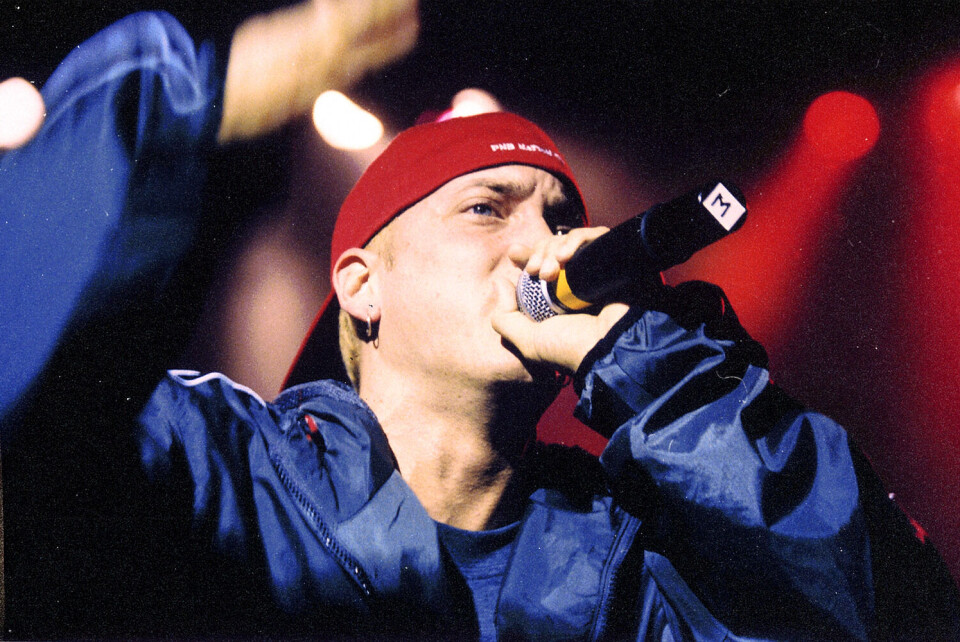
Rapper Eminem, performs at the Paradiso on April 30th 2000 in Amsterdam, Netherlands.Photo by Frans Schellekens/Redferns.
“The Real Slim Shady” forecasted the storm to come. Conceived as a last-minute effort to generate a hit single, the cut is powered by relentless agility and the acerbic wit of the Smart Ass Final Boss. The track sees Em scribble around the Y2K zeitgeist as he rewrites boomer fairy tales in crayon and splashes of blood.
“We ain't nothin' but mammals / Well, some of us cannibals who cut other people open like cantaloupes / But if we can hump dead animals and antelopes / Then there's no reason that a man and another man can't elope.”peaked at No. 4 on the Billboard Hot 100 chart
He continues the technical and thematic pyro show on less-heralded tracks like, “Who Knew.” For that one, he sifts through various American lies with a satirist’s ruthless insight and an architect’s instincts for infrastructure. At the end of his last verse, he pokes fun at people blaming rap lyrics for school shootings, assembling and disassembling vowels, consonants and, critical rhetoric all the while: “How many r***rds'll listen to me / And run-up in the school shootin' when they're pissed at a teac- / -her? Him? Is it you? Is it them? / Wasn't me, Slim Shady said to do it again!” The part where he breaks up the word teacher to go into a small barrage of finger-pointing is Tony Stark-level re-engineering — flipping twisting and rerouting parts to build new Iron Man tools instantaneously. A micro masterpiece of ingenuity and focus.
And then there’s “Stan.” Jolting and driving across a haunting Dido sample, Em tells a story of the most warped kind of fandom. Developing an obsession with Em, a young man writes a series of increasingly disturbing letters before committing the type of heinous act Eminem imagines on tracks like “’97 Bonnie & Clyde.” Em then concludes the tale with an M. Night Shyamalan-esque twist of an ending, before those became run-of-the-mill in rap music. The track charted fairly well — it peaked at No. 51 on the Hot 100 in an era that was much more difficult for rap to dominate — but its cultural footprint is the astonishing part. In 2017, “Stan,” which had since come to define fans who are irrationally attached to a particular celebrity, was added to the Oxford Dictionary. While his peers were writing rhymes, Em was basically helping rewrite the dictionary.
Advertisement
While Em’s technical accomplishments are… well, accomplished, his cultural analysis is just as compelling. During an era of mass-produced boy bands and hollow moralizing, Em’s verbal defilements spotlighted the U.S.’s hidden absurdities: how could you be worried about fictional violence in a world where we’ve started wars with countries just to take their oil? How could you be mad about sexual content when your acting president is getting head from his intern? In 2002, Bill O’Reilly’s criticism caused Pepsi to take away Ludacris’ sponsorship. Years later, he ironically was forced to settle several sexual harassment lawsuits. These events unfolded after The Marshall Mathers LPhit shelves. But they’re all fruits of the same philosophical asymmetry Em explored in his magnum opus, and they’re largely as true now as they were then. When The Marshall Mathers LP was released, Bill Clinton was our president. Trump is our current one. Like the greatest poets, Em’s best words are both of their era and eternal — a delicate balance struck at the intersection of wit and understanding.
Remarkably, Eminem’s own commercial success accurately reflected both his impact and skill set. This wasn’t a case of an underground wordsmith who could only sell to purists. In its first week of release, The Marshall Mathers LPsold 1.78 million copies. The villain won: The guy who made a song about killing his wife and taking his daughter along for the ride with the body sold more first-week copies than the group that made “I Want It That Way.”
Vol. 3... Life and Times of S. CarterStankoniaAnd Then There Was XMarshall Mathers LP
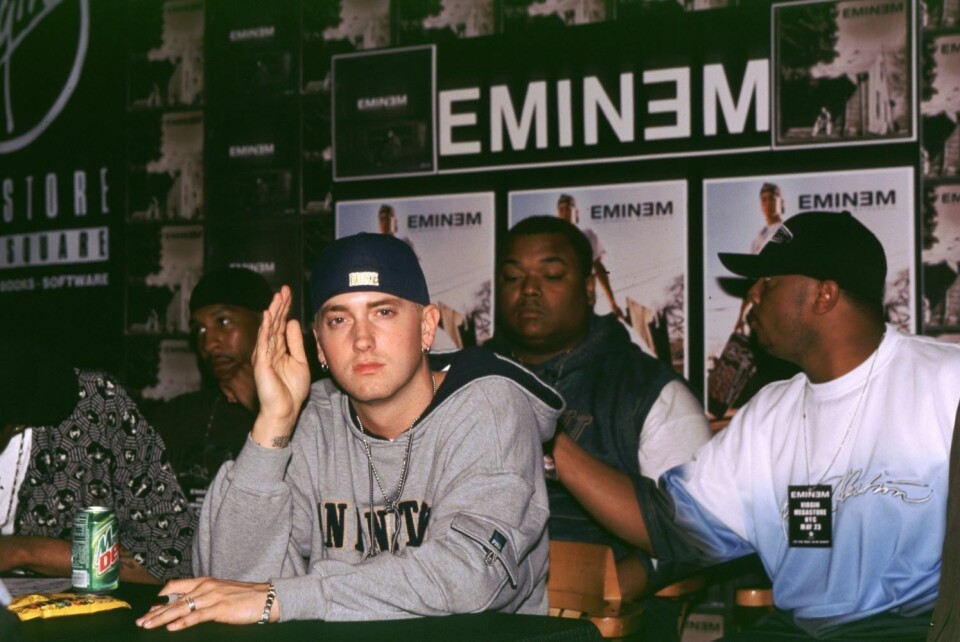
Eminem during Eminem signing his new release "Marshall Mathers LP" at Virgin Record Store - Times Square in New York City, New York, United States.Photo by KMazur/WireImage
Yeah, he’s white, and yeah, that helps. But that came with forgotten limitations, too. Rather than being limited by an inability to distill drug-dealing vignettes or Afrocentric fantasies, Em chose to focus on deep-frying middle American values. Basically, he sold records to white people by … talking about white people shit. And let’s be clear: the idea of making a song like “Kim” — wherein you tell the story of arguing with your wife before killing her — is some very white shit. So are all the bars about his and his mother’s drug addiction, which hit more than a little differently amid an ongoing opioid crisis in lower-income white neighborhoods. Em’s cultural prescience, bleak humor, and raw penmanship led to something genuinely novel, reaching crevices that his contemporaries couldn’t reach — if they had ever even thought to reach for them.
Twenty-five years removed from its release, The Marshall Mathers LP is a masterpiece of … basically, everything. If there is a flaw, it would be the inexcusable flurries of homophobic and sexist slurs. Yes, Em’s lyrics were, as he would argue, tongue-in-cheek exercises in absurdist humor. But that doesn’t mean they didn’t embolden people who took his words literallyand make life more difficult for marginalized communities everywhere. That’s a stain no surprise Elton John guest appearance could remove. In retrospect, these spurts of needless offenses scan just as heinously. They can easily get called out today. They were heavily protested in 2000, too. But like the most powerful forces in nature, Em endured. And rose. In 2000, no rapper — nobody — elevated higher.